
What is an eRideable?
An e-rideable is an electric rideable device that:
- Has at least one wheel
- Is designed for one person
- Does not go faster than 25km/h
- Weighs 25kg or less
- Is no more than 125 cm long and 135 cm high
Common types of eRideables include: eScooters, eSkateboards, eUnicycles, eWheels and eSkates.
eRideables are NOT: eBicycles, segways, low powered motorsied scooters (less than 200 watts and 10/km/hr), electric wheelchairs or mobility scooters.
eRideable injuries in Western Australia
With the increasing popularity of eRideable devices, there has been a corresponding rise in associated injuries.
The WA State Trauma registry reported:
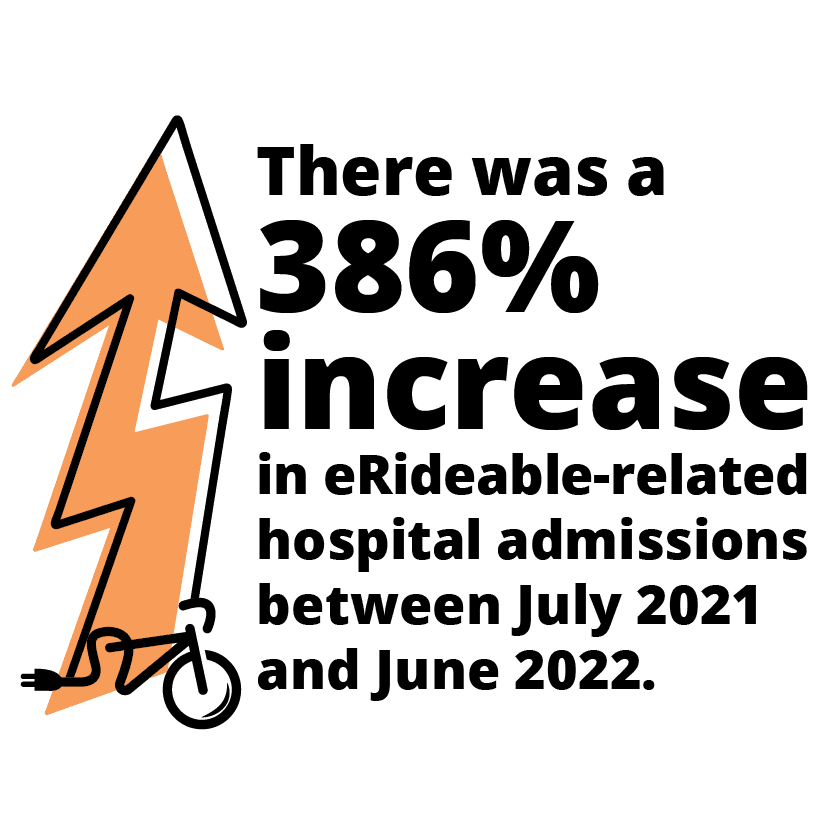
- A 386% increase in eRideable-related hospital admissions between July 2021 and June 2022, recording 54 hospital admissions.1
- Between July 2017 and June 2022, 81 patients on the WA State Trauma registry sustained eRideable-related injuries.3
- 57% were not wearing a helmet at the time of the incident.
- 35% were under the influence of alcohol or drugs at the time of the incident.31% of incidents resulted in major trauma.
- 54% of admissions required surgery.
- 80% of admissions were male.
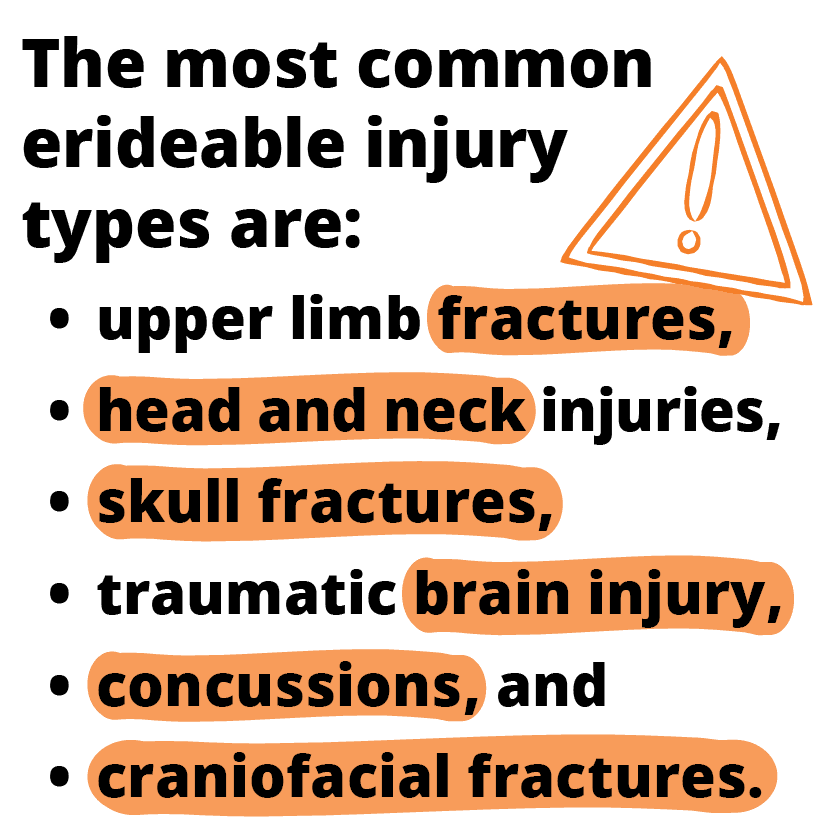
- Head injuries were identified as the most common injury, followed by upper limb injuries and lower limb injuries
- Helmet use was associated with a significantly lower likelihood of sustaining a head injury compared to those who do not wear a helmet. 3
How do we reduce the incidence and impact of eRideable injuries?
Research suggests strategies such as educational campaigns, effective user training, rule enforcement, improved technology for shared devices (i.e. geofencing) and restricting use when risky behaviours are detected, can positively influence the impact of eRideables.4-6
Dedicated micromobility infrastructure, particularly physically separated lanes for eRideables have been shown internationally to reduce rider-vehicle conflicts and improve safety for all road users.2 Protected lanes reduce crash frequency and severity, support safer navigation at higher speeds and provide an environment better suited to the characteristics of eRideable.
Improving the built environment such as providing adequate lighting, smooth surfaces, safer surface transitions and designated parking spaces, can reduce falls, clutter-related hazards and crash risk.2 Evidence shows that poor surface transitions dramatically increase crash likelihood, which dedicated parking zones improve compliance and reduce pedestrian obstructions.
Targeted safety campaigns, particularly those addressing younger riders, sober riding, helmet use and responsible operating behaviours are essential.2 Studies indicate that alcohol and other drugs contribute substantially to severe eRideable injuries, highlighting the need for public education and enforcement.
Discover programs in Western Australia
WA Road Safety Commission
The Road Safety Commission works to reduce road trauma on Western Australian roads, responding to road users presenting the highest risk.
Westcycle
WestCycle works to support safer riding conditions, better infrastructure and increased participation.
Discover other organisations
Steering Healthy Minds
Steering Healthy Minds is not a crisis service. Steering Healthy Minds (SHM) is a collaboration between key organisations with interests...
SHOPRIDER AUSTRALIA
Shoprider Australia is the Mobility Scooters and Powerchairs specialist providing a range of high quality and reliable mobility equipment. With...
Know Injury
The Know Injury program provides knowledge, skills and networking opportunities, to support and enable practitioners to deliver evidence-informed injury prevention...
Road Trauma Support WA
Road Trauma Support WA provides information, support and counselling to anyone in WA who has been affected by a road...
Western Australian Centre for Road Safety Research
The WA Centre for Road Safety Research has been established to conduct research using the Safe System Approach. With a...
Farmsafe Australia
Our mission is to improve the wellbeing and productivity of Australian agriculture through enhanced health and safety awareness and practices.
References
- Raubenheimer, K. et al. Western Australian State Trauma Registry analysis of incidence and injury patterns associated with e-Scooter injuries: 5-year retrospective case series. ANZ J. Surg. 93, 1890–1895 (2023).
- Government of Western Australia, Road Safety Commission. Review of the eRideable Road Rules. https://www.wa.gov.au/system/files/2025-05/rsc433_erideable_report_may_2025.pdf (2025).
- Briotti, J., Sexton, L., Robson, J. & Nasim, S. A 12-month retrospective cohort study investigating the incidence and short-term outcomes of e-scooter injuries in regional Western Australia. ANZ J. Surg. 94, 1995–1999 (2024).
- Roberts, P., Yan, A. & Hasan, R. Risky behaviour and regulation compliance in eRiders and cyclists in metropolitan Perth Western Australia. Transp. Res. Part F Traffic Psychol. Behav. 114, 513–534 (2025).
- Moftakhar, T. et al. Incidence and severity of electric scooter related injuries after introduction of an urban rental programme in Vienna: a retrospective multicentre study. Arch. Orthop. Trauma Surg. 141, 1207–1213 (2021).
- Pakarinen, O., Kobylin, A., Harjola, V.-P., Castrén, M. & Vasara, H. Speed and Nighttime Usage Restrictions and the Incidence of Shared Electric Scooter Injuries. JAMA Netw. Open 6, e2341194 (2023).
