
The Australian Institute of Health and Welfare (AIHW) has released updated web reports of injury-related emergency department (ED) presentations, hospitalisations, and deaths in Australia.
Over the past decade, the rate of fall injury hospitalisations has gradually increased, as well as the number of injury deaths caused by falls. Falls were the leading cause of injury hospitalisations in 2024–25, and the leading cause of injury deaths in 2023–24. Alarmingly, over 95% of deaths from falls were among people aged 65 years and over. Fall-related injuries are estimated to have cost the health system about $5.4 billion.
In 2024-25, Western Australia had the lowest rate of falls-related hospitalisations in Australia (578.9 per 100,000). However, there was a reported increase of about 10% in age-standardised death rates, increasing from 18.0 per 100,000 in 2022–23 to 19.7 per 100,000 in 2023-24, making WA the second-highest state for falls deaths.
Falls resulted in:
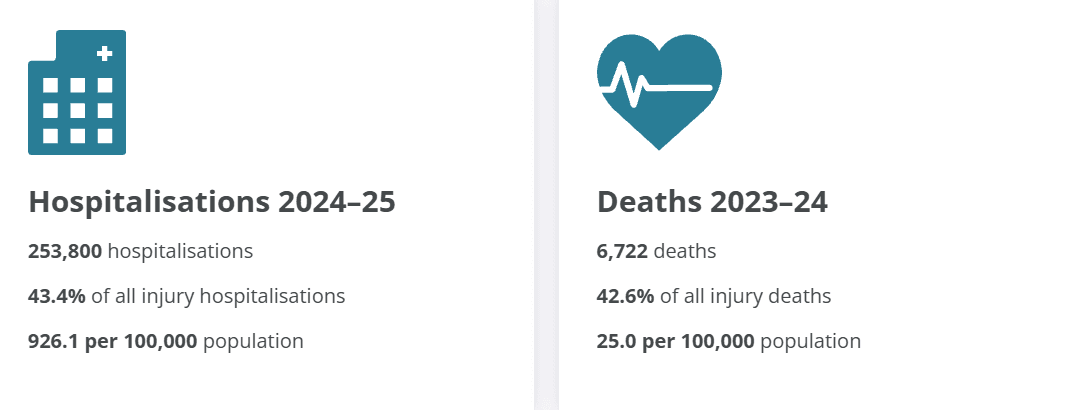
Other key findings included:
- People aged 65 and over were hospitalised for falls 12 times more often than adults aged 25 to 44.
- For fall-related injury hospitalisations 140,836 cases (55.5%) were females and the rate for females (1,020.7 per 100,000) was 1.2 times that for males (829.3 per 100,000).
- For fall-related injury deaths 3,405 deaths (50.7%) were females and the rate for females (25.1 per 100,000) was similar to that for males (24.8 per 100,000).
- Falls on same level from slipping, tripping and stumbling caused most hospitalisations (297.5 hospitalisations per 100,000) while unspecified falls caused the most injury deaths.
- The hospitalisation rate was 1.7% higher than the previous 5-year average of 910.5 per 100,000 population.
- For fall deaths, the crude rate was 7.1% higher than the previous 5-year average rate of 23.3 per 100,000 population
- The most common types of falls resulting in hospitalisation among people aged 65 and over were same-level slips, trips and stumbles.
- The three body parts most frequently injured in fall-related hospitalisations were head and neck, hip and lower limb, shoulder and upper limb.
- Fractures were by far the most common type of injury during fall hospitalisations (53.3%). The most frequent injuries by body part were fractures to the shoulder and upper limb, and fractures to the hip and lower limb.
- Home was the most common specified place of occurrence for fall-related injuries across all age groups (44.8%) and doing daily living activities was the most commonly specified activity undertaken when injured (11.3%).
- The average length of stay in hospital for fall-related injuries was higher than for all hospitalised injuries.
Aboriginal and Torres Strait Islander people
- There were 9,346 hospitalisations due to falls in 2024–25 and 73 deaths due to falls in 2023–24.
- Hospitalisation rates were highest among people aged 65 and over.
- The mortality rate was similar for males and females (7.4 and 6.8 per 100,000 population, respectively)
- Compared to non-Aboriginal Australians, Aboriginal people are 1.4 times as likely to be hospitalised due to a fall in 2024–25 and equally likely to die from a fall in 2023-24.